
What Is Gematria?
Gematria in Kabbalah Explained
- Gematria is the numerical value of a spiritual state, i.e., of a state in which a spiritual vessel discovers the Creator.
- Gematria is expressed in Hebrew letters and their combinations.
- Numbers in Hebrew come from letters, with Gematria revealing the spiritual forces behind words and their meanings.
Introduction to Gematria
Gematria is the numerical value of a spiritual state, that is, of a state in which a spiritual vessel discovers the Creator, which is expressed in letters and their combinations. A “spiritual vessel” is precisely an internal desire that we develop to become congruent with spiritual qualities of love and bestowal—the Creator’s qualities.
Suppose we are in a certain spiritual state. Why are we in it? It is because our desires have acquired a certain level of resemblance to the Creator, the upper force of love and bestowal, which fills us with that very quality.
The force or quality of love and bestowal fills our desires according to the law of equivalence of form. This means that our desire, by becoming similar to the Creator, becomes filled by the quality of love and bestowal. It delights in that fulfillment, which means that we become similar to the Creator in such a state.
It is possible to measure such a state according to our desire and the extent to which it has changed in intensity, volume, depth, and coarseness. When we measure the extent and volume of this transformation, we see how much our inner desire has become similar to the Creator. We measure and calculate the positive change in our desire and the different kinds of qualities of love and bestowal in it. This is called “Gematria.”
The Gematria of a certain object or soul represents the intensities, degrees, or states of correction that emerge from our equivalence of form with the Creator. Therefore, if we are dissimilar to the Creator, we have no Gematria value. The moment we become like the Creator, Gematria appears in us.
The Creator created only one desire and it acquires His qualities to the extent of its similarity to the Creator. It then attains a certain volume, a specific form, and that volume bears a name. What name? The measure of equivalence with the Creator.

Letters and Numbers in Kabbalah
Letters in Hebrew have numerical values. But what is a letter? The Hebrew alphabet is entirely spiritual, that is, it is a means to express spiritual states. These letters were not invented. They were extracted from the research of Kabbalists who studied the nature of the spiritual world.
Moreover, there are no numbers, only letters. Letters symbolize movement from the upper to the lower, from the Creator to the created beings. They represent the extent to which the created beings can perceive the influence of the Creator over them. That is why a letter is also called a sign (Ot in Hebrew), meaning it symbolizes that we start perceiving the relationship of the upper force toward us.
We begin to perceive the upper force by wanting to perceive it. Our desire to perceive the Creator or the upper force is the extent of our equivalence of form. When we develop a desire to love and to bestow, to fulfill the Creator, we begin to sense that the Creator already holds a similar disposition toward us. Here, the connection between the Creator and the created being appears. This mutual connection leads to mutual fulfillment: we elevate our desire toward the Creator, and the Creator fills that desire with His presence. This is the essence of the relationship between the Creator and the created being.
Our desire for the Creator is symbolized by a black dot, line, or shape on the white background of the upper light. The mutual influence of one over the other—the person on the Creator and the Creator on the person—creates a complete system of interaction.

The 22 Hebrew Letters
The mutual qualities between us and the Creator form the 22 Hebrew letters. Additionally, there are five final letters that appear at the ends of words. Unlike capital letters in other languages, these ending letters (abbreviated as “Mantzepach”) serve a unique function in Hebrew. The letters, taken together, represent the cascading of the upper light into our desire.
Sounds of the Hebrew Letters
Hebrew letters are categorized by how they are pronounced, with the use of the lips, teeth, cheeks, tongue, and throat. This classification represents five groups of sounds. In addition, Hebrew has no vowels. Vowel sounds are indicated by points and lines above or below the letters.
What is the significance of a dot, a line, and how they surround the letters? A dot is like the beginning of creation. It symbolizes an egoistic desire that appears against the white background of the upper light, which represents the Creator’s influence. This dot can then expand in different directions, which represents the unfolding of creation.
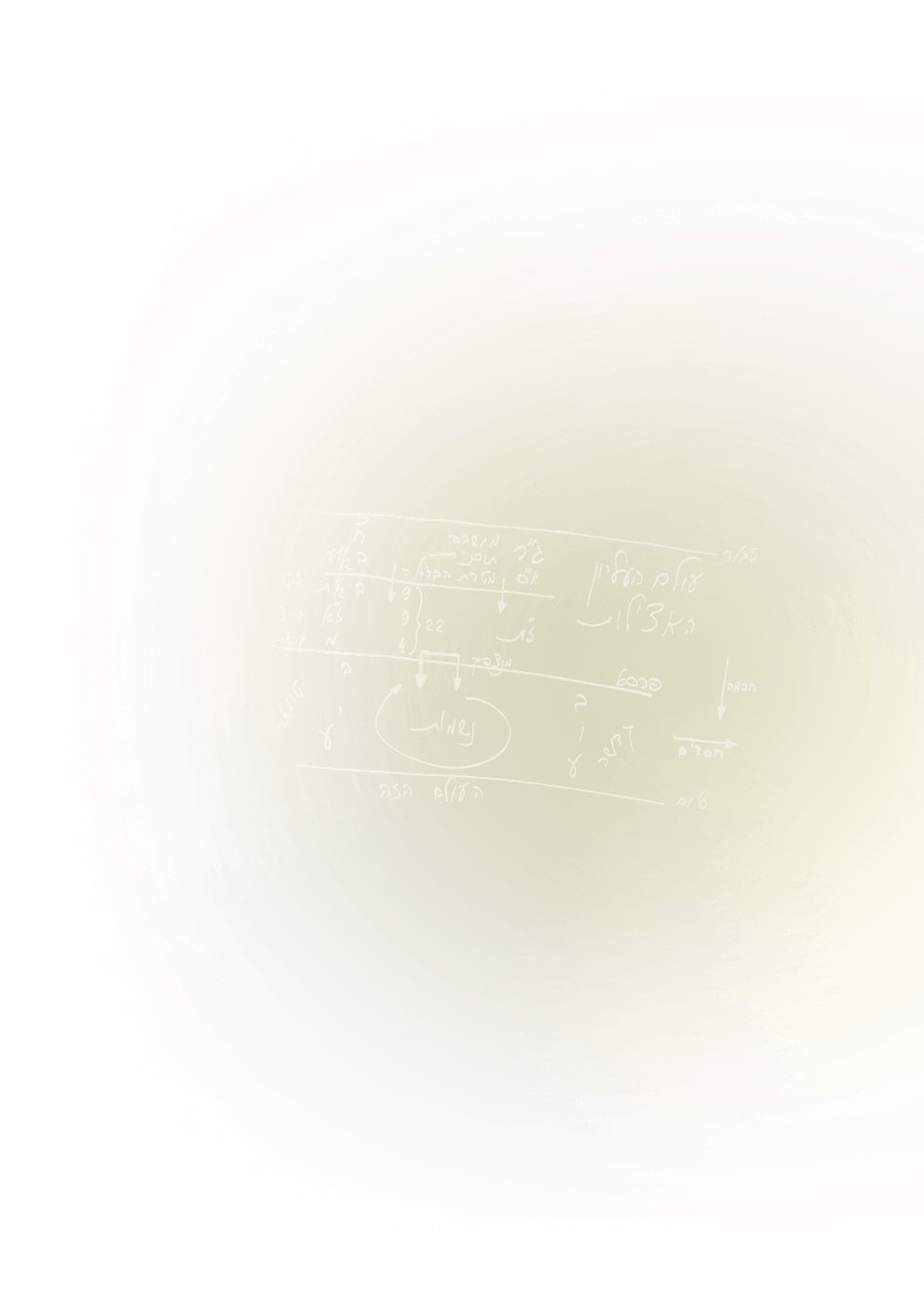
The black dot’s movement on the white background symbolizes the entire spectrum of relationships between the Creator and the created being. There are nine letters from the lower part of Bina, another nine letters from Zeir Anpin, and four letters from Malchut, making up the 22 Hebrew letters.

The Spiritual Meaning of Names and Letters
Letters thus express the relationship between the Creator and the created being, as Kabbalists—people who directly attain this relationship—describe it. The formation of a letter represents how we perceive the Creator’s influence upon us. A word, made of multiple letters, represents a sequence of qualities flowing from one to another, which express deeper meanings.
It is important to understand that these letters were no human invention. Instead, people who felt the Creator’s influence over themselves expressed this influence in such a way. Hebrew was the first language to emerge in our world because it expresses what we feel from the Creator’s influence.
The only differentiation between us and the Creator is that our desire is an egoistic desire to receive for our own sake. If we want to receive the Creator’s influence, we need to become like the Creator, all loving and all bestowing. Accordingly, by rising above our desire to receive and becoming bestowing and loving like the Creator, we discover the Creator’s influence upon us and write it down in a structured way.
Why is Hebrew Written from Right to Left?
Hebrew is written from right to left because the right side symbolizes the Creator’s qualities of wholeness and perfection, while the left side symbolizes imperfection. We even use this concept in everyday speech: the right side represents something good, while the left represents something flawed. In Hebrew, writing flows from right to left because everything comes from the Creator.

What About Numbers?
There are no numbers in Hebrew as we understand them today. Instead, letters represent numerical values. For example: Yod (י = 10), Kaf (כ = 20), and Lamed (30 = ל). Each letter serves a dual purpose. It represents both a letter and a number. Larger numbers are formed by combining letters.
Gematria is the numerical value of words, expressing their inner spiritual force. The numbers themselves hold no significance. It is what stands behind them that matters. For example, the word Elohim (אלוהים), which means “God,” has a Gematria value of 86. This number represents a specific force. If a Kabbalist sees this number, they immediately understand what kind of spiritual connection is being described. Accordingly, Kabbalist Yehuda Ashlag (Baal HaSulam) describes how God and Nature describe the very same force as they share the same Gematria value, since the word for “nature” in Hebrew, “HaTeva” (הטבע), also equals 86.
There are thus no secrets in the wisdom of Kabbalah, only hidden meanings that we need to uncover. Understanding Gematria requires knowing and feeling what stands behind the letters and numbers.
Kabbalistic Excerpts Mentioning Gematria Values
The following is a selection of excerpts where various Kabbalists mention Gematria values in their texts. They are provided here solely in order to give an impression of how Kabbalists who attain degrees of equivalence of form with the Creator can express such a connection.
The following is a selection of excerpts where various Kabbalists mention Gematria values in their texts. They are provided here solely in order to give an impression of how Kabbalists who attain degrees of equivalence of form with the Creator can express such a connection.
The Gematria (numerical value) of 32 designates the Hebrew word “Lev” (heart), 22 letters and 10 dots that constitute the basic forms of the world filled with wisdom and life. The name of HaVaYaH includes in itself all the forms of writing and speech, because the structure of letters consists of lines and dots, where every dot is a contraction and every line is an expansion.
-Kabbalist Dr. Michael Laitman, “Four Worlds.“
The Gematria of the word Tardema (sleep) matches that of the word Targum (translation). In Hebrew, the word Targum is spelled with the same letters as the words Tered MA, which means “descending MA,” for through this spiritually impure language, AHP = MA (designated by the words Tered MA) becomes revealed. This leads to the descent from the scale of merit to the scale of punishment. While this is happening, the state of GE is called “sleep.”
-Kabbalist Dr. Michael Laitman,
The Zohar: Annotations to the Ashlag Commentary,
section “Heaven and Earth.“
He who understands consists of several levels-degrees, for he sees into every thing and knows for himself and for others. The mark of him who understands is formulated in the phrase: “The righteous one knows his animal soul.” The righteous one signifies Yesod that passes the Light to Malchut (animal), for the Gematria of HaVaYaH of Malchut is fifty-two = BON = BeHeMaH (beast) = Bet- Hey- Mem- Hey = 2 + 5 + 40 + 5 = 52. Malchut constitutes the level called “wise at heart,” as wisdom is found within the heart. But he who understands, sees Above and below, for himself and for others. He who is wise designates Malchut, for it is Malchut that reveals wisdom. He who understands is Yesod that stands above Malchut. Ohr Hochma in Malchut shines only from below upwards. It is impossible to receive the Light from Above downwards, as it would surely enter egoistic desires. Therefore, it is said that the wise (Hacham) sees only for himself, from himself upwards, and cannot pass the Light to
others below.
-Kabbalist Dr. Michael Laitman,
The Zohar: Annotations to the Ashlag Commentary,
section “The Intention in the Prayer.“
Before the world was created there was “He and His name are one.” This means that there was no difference between the light, which is called “He,” and “His name,” which is the Kli, meaning the will to receive. He interprets that the Kli is called “His name” because Shmo [His name] in Gematria is Ratzon [desire].
-Kabbalist Baruch Ashlag (RABASH), “Letter No. 73.“
It is written in The Zohar (Pinhas, Item 630), “‘Full,’ which is said regarding a cup of blessing, is as it is written, ‘A cup full of the blessing of the Lord.’ So a man should be whole, as it is written, ‘And Jacob came whole.’ There must not be any flaw in it, for ‘all that has a blemish will not approach.’ Likewise, the letters Aleph-Lamed-Mem [mute] with Yod-Hey are the letters of Elokim [God], are as the count of ‘cup,’ namely eighty-six [in Gematria]. For this reason, the cup must be full, for if you reverse the word Ilem [Aleph-Lamed-Mem, mute], you will find Maleh [full], for the [word] ‘cup,’ in Gematria, is ‘full,’ Yod-Hey.”
-Kabbalist Baruch Ashlag (RABASH),
“What Is, ‘A Cup of Blessing Must Be Full,’ in the Work?“
Now we can understand what our sages said, “If he swallows” the Maror “he will not come out.” The ARI says about this that Maror has the Gematria of Mavet [death], which is judgments. We should ask what it implies that Maror has the Gematria of Mavet. The thing is that the Maror we eat is a reminder that they made their lives bitter with hard work. We should say that in the work, “hard work” means that it is difficult to overcome and emerge from self-benefit, and that he wants to work only for his own benefit. This is called “wicked,” who asks, “What is this work” of bestowal “for you?” What will you gain out of it? But it is known that “The wicked in their lives are called ‘dead.’” It follows that hard work is called Maror, when a person tastes bitterness in having to work for his own sake. This is the intimation that Maror has the Gematria of Mavet and judgments, since there was a judgment on self-benefit that it is forbidden to use this Kli [vessel], and this is why there are restrictions and concealment there.
-Kabbalist Baruch Ashlag (RABASH),
“What Is, He Swallowed Maror [Bitter Herb],
He Will Not Come Out, in the Work?“
According to the rule that the Torah is studied in a singular authority, it follows that his three friends, Aner, Eshkol, and Mamre were within him.
After he heard the Creator’s commandment, he went to his body so they would observe the Creator’s commandment. At that time, there were three views in his body: 1) Aner, which is 320 in Gematria, implying the 320 sparks in the body. In the 320, there is still the stony heart, which says, “I can do everything required of me, but I need to understand what I must do.”
The second one, Eshkol, comes from the word Eshkol [I will weigh/decide], meaning he weighs the matter. Once Aner said that he is a boy who does not understand what is required of him, Eshkol comes and weighs the benefits, meaning what the will to receive gains
from this.
Sometimes, he also has the quality of Mamre, who counters the old man of Mamre, for “old man” is called “an old and foolish king.” Here Mamre speaks against Aner and Eshkol, arguing that he wants to go against reason, which is the quality of Aner, and against the will to receive, which is Eshkol.
-Kabbalist Baruch Ashlag (RABASH),
“350. The Lord Appeared to Him by the Oaks of Mamre“
Every person must experience that transit period of concealment of the face. When he completes it, he is rewarded with open Providence, meaning the revelation of the face. And before he is rewarded with revelation of the face, and although he sees the posterior side, he cannot refrain from ever committing a sin. Not only is he unable to keep all 613 Mitzvot, since love does not come by coercion and compulsion, but one is not complete even in the 612 Mitzvot, since even his fear is not fixed as it should be. This is the meaning of the Torah being 611 in Gematria (any Gematria is the posterior side), that one cannot properly observe even 612 Mitzvot. This is the meaning of, “He will not always contend.” In the end, one will be awarded the revelation of the face.
-Kabbalist Yehuda Ashlag (Baal HaSulam),
“Introduction to the Study of the Ten Sefirot.“
HaTeva (the nature) has the same numerical value (in Hebrew) as Elokim (God)—eighty-six. Then, I will be able to call the laws of God “nature’s Mitzvot (commandments),” or vice-versa, for they are one and the same.
-Kabbalist Yehuda Ashlag (Baal HaSulam), “The Peace.“
Nature in Gematria is Elokim [God]. Therefore, everything that nature mandates … the word of the Creator. The benefit of society is the reward and the damage to society is
the punishment.
-Kabbalist Yehuda Ashlag (Baal HaSulam),
The Writings of the Last Generation, Part Four.